
Archive for the ‘Love’ Category

Mark Twain presents certain tenets in his novel Adventures of Huckleberry Finn, which a casual reader will not easily discern.  From social commentary to religious ideology, he blends humor, satire, and adventure into a statement and a critique about the issues of his time and our own.  A “gospel,” of sorts, is established by focusing on the religious themes Twain merges with the identity of his character, Huck Finn.  Huck’s religious beliefs, his gospel, are not as far off the mark as he believes.  A gospel is supposed to be “good news,” but the religious beliefs that many tout as truth cannot be construed as good news in any way.  The religious beliefs that Huck exhibits, even if he does not see them as such, are closer to the Gospel of Christ than many church-going, religious people demonstrate, both then and now.

Providence is a word that is uncommon in religious exhortation today.  Typically, people use words and phrases such as God’s will, plan, purposes, direction, and especially his activity in this world to allude to the idea of Providence.  God is supposed to be guiding, directing and controlling the events and circumstances that surround us all, according to a number of conflicting expositions.  The Widow Douglas, who is Huck’s guardian, and her sister, Miss Watson, each take their own opportunity to instruct him in their interpretations, as he divulges:

Sometimes the widow would take me one side and talk about Providence in a way to make a body’s mouth water; but maybe next day Miss Watson would take hold and knock it all down again. I judged I could see that there was two Providences, and a poor chap would stand considerable show with the widow’s Providence, but if Miss Watson’s got him there warn’t no help for him any more.  (115)
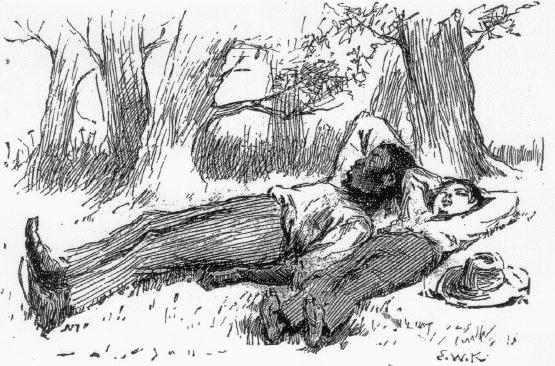
Huck recognizes the discrepancies between the two views in which he is instructed.  These two views, with many variations, are still influential today.  God’s love is manifest in some teaching, but his wrath, anger, and judgment are the defining characteristics in most.  Huck instinctively realizes that a god that is mostly angry is one which cannot be easily appeased.  As events in his life unfold, with his abusive father, an enslaved friend, and a perilous journey, Huck has to be wondering where and how this god is working in his life.

Christianity today, especially the southern flavor, has a lot to say about an eternal destination for all.  Heaven and hell, everlasting bliss or infinite torment, the good place or the bad, supposedly form a dichotomy with no alternative; however, there are a multitude of descriptions for either one being taught every Sunday morning.  The Widow gives Huck her description of the “good place,” and he informs us, “She said all a body would have to do there was to go around all day long with a harp and sing, forever and ever. So I didn’t think much of it” (110).  From the beginning of Christianity, heaven has been described as an ethereal realm of clouds and singing cherubs, a fantastic Oz-like domain of golden streets and bejeweled gates and walls, or a vast throne-room where everyone gathers to offer everlasting praise and adoration to the creator.  After establishing his view concerning the good place, and wanting no place in it, Huck asks the Widow if she thinks his friend, Tom Sawyer, will make it in, and she assures him that Tom will not.  Huck declares that he “was glad about that, because I wanted him and me to be together” (110).  Huck’s impression of the eternal destination the Widow describes does not suit his adventurous soul, and he instinctively grasps concepts concerning love, community, and brotherhood that most of the faithful fail to ascertain.  Huck’s love for Tom is even more important to him than where they might be headed.

The Grangerfords introduce Huck to hypocrisy in the manifestation of brotherly love.  The Grangerfords are a kindhearted, church-going family who take Huck in when a steamboat hits his raft, and he is separated from Jim, the runaway slave and his traveling companion on the journey down the river.  Huck attends a church service with the family and makes the following observations:

It was pretty ornery preaching — all about brotherly love, and such-like tiresomeness; but everybody said it was a good sermon, and they all talked it over going home, and had such a powerful lot to say about faith and good works and free grace and preforeordestination, and I don’t know what all, that it did seem to me to be one of the roughest Sundays I had run across yet.  (183)

The Grangerfords think the sermon is good, and they have a long discussion about some of the precepts of their religion, like faith, good works and others.  Huck says the sermon was about “brotherly love” and other “tiresomeness,” and he describes it as “pretty ornery.”  The preaching was ugly and unpleasant in his opinion, but Huck does believe in brotherly love, even if he does not recognize this fact.  Huck finds the whole day, in his words, rough.  Is it the subject matter of the sermon, or the discussion that follows by his foster family?  It is probably the hypocrisy of the Grangerfords and all the other religious folk that he has observed.  This same family who has taken him in and is having lively discussions about brotherly love and good works is at the same time in a deadly feud with their neighbors, the Shepherdsons.  Huck again recognizes the inadequacy of this revealed gospel.

Huck seems to grasp the important concepts from the bible as evidenced in his conversation with Jim about King Solomon’s ruling concerning a disputed child.  Jim believes Solomon is not wise at all when Solomon decrees that the child be cut in half to satisfy the claim of both women who profess to be the child’s mother.  But Huck understands the reasoning of Solomon; the true mother will love the child enough to give it up.  Huck intuitively grasps the essence of love.

In the bible, Paul instructs Timothy to command the people of Ephesus “not to teach false doctrines any longer or to devote themselves to myths and endless genealogies. Such things promote controversial speculations rather than advancing God’s work—which is by faith”  (1 Timothy 1:3-4, NIV).  On another occasion, when the Widow Douglass is telling Huck about Moses, he is excited in the beginning of the story but then “she let it out that Moses had been dead a considerable long time” (109).  Huck did not care to hear about Moses after this because he “don’t take no stock in dead people” (109).  There are many things that people of faith argue about: Should the creation account be understood as literal?  Was the biblical flood local or world encompassing?  What are appropriate dietary prohibitions?  Should I refrain from cutting grass on the Sabbath?  What should I read or watch for entertainment?  This agenda of exclusion comes from dead people, while the agenda of inclusion, the law of love, comes from someone living.  In stating that he takes no stock in dead people, Huck is standing beside Paul and discrediting those who exclude.  Huck understands the revelation, without acknowledging it as such, that the Old Testament is not the governing authority for true followers of Jesus.  Huck knows, subconsciously, that the Gospel of Christ is the only way to advance God’s work, and he unwittingly works for this cause.

Huck Finn’s crisis of faith comes when he feels the conviction of sin in his actions that involve helping Jim, a runaway slave, to escape.  He has grown very fond of Jim, but he feels that he is at the junction between heaven and hell.  He prays, then feels worse, and finally writes a note that will give Jim up to the slave’s owners.  Huck then achieves a sense of relief but is still not completely satisfied.  He again wrestles with his conscience.  He knows that he should obey the law and turn Jim in, which is good and should help in any bid for heaven, but he wants to help Jim, which is bad, and he believes this will land him in hell.  He stands at this juncture holding the note he has written and makes his decision.  He says to himself, “All right, then, I’ll go to hell” (246). Huck does not wholly divulge his beliefs regarding the netherworld, but they are probably in line with most of the teachings of the fundamentalist churches of the southern states today.  In choosing hell rather than turning Jim in, he believes he has sentenced himself to eternal torture in a lake of fire.  He understands that the fire will ravage him but never consume him.  This interpretation of a pain-ridden eternal destination for sinners is what most of the faithful convey to the masses, but Huck’s love for Jim, as well as his desire to help free him, actually allow Huck to make the truly righteous choice.  In choosing hell, and going against the predominant teachings of his day, Huck is really choosing heaven.

Mark Twain uses the character of Huck Finn to convey some of his own misgivings and solicitude about organized religion and what it conveys to the masses.  Twain’s allusions to these teachings and the bible provoke thought and consideration when they are held up against contemporary issues in any era.  Through Huck Finn’s moral growth and religious deliberation, Twain addresses a number of issues.  Is God in control?  How is he working in this present space and time?  Whose view is right about eternity?  What in the bible is really important?  Sin, choice, hypocrisy, love-what is the truth concerning these issues?

Huck Finn is a fourteen-year-old boy who is making life decisions that are more Christ-like than most bible-thumping, fundamentalist, southern Christians.  He does make mistakes in judgment, like when he allows Tom to torment Jim on a few occasions, but his love and concern for others is readily apparent.  He concludes rightly that a wrathful, vengeance-seeking god cannot be satisfied.  He perceives the hypocrisy embodied in the sermons and actions of the religious assemblies to which he is exposed.  Heaven, hell, and eternity are concepts he does not pretend to understand fully.   Jesus said, “So in everything, do to others what you would have them do to you” (Matthew 7:12 NIV), and Huck personifies this scripture.  Excluding his childish pranks, Huck does not want anyone to come to a bad end.  He never wishes harm on anyone, even those who do him harm.  Jesus, when asked what the greatest commandment was, replied, “Love the Lord your God with all your heart and with all your soul and with all your mind.  This is the first and greatest commandment.  And the second is like it: ‘Love your neighbor as yourself.’ All the Law and the Prophets hang on these two commandments” (Matthew 22:37-40 NIV).  Huck never reveals any love for God, but his actions epitomize love for his neighbor.  In a time when it is considered right, moral, and even biblical to enslave a human being and treat him like disposable property, Huck makes a choice to burn in an ever-lasting hell rather than turn a friend back over to the institution of slavery.  The gospel, according to Huck, is simply love for others.  It is seeing humanity as a community of equals, all deserving the same treatment.  This is what Jesus tried to emphasize, the very thing for which he gave his life.  As far as Huck’s love for God, he ultimately proves it in his actionable love for his neighbor.  This is truly the gospel, and it is good news for all who love and are loved.

You probably read the title and might be wondering what in the world I am talking about.  Atheism was not as hard as what?  The answer is atheism was not as hard as Christianity.  At this point some of you are probably thinking I am crazy, but hold on.  Am I?  Do you find Christianity easy?  If you do then I simply have to ask which Jesus you are following.

I know, before some of you even say it, loving a wonderful, merciful, savior is easy.  Loving God as Father is easy also.  He is so very easy to love when you get a taste of His incomprehensible mercy, amazing grace, and unsurpassable peace.  The very real fact that He rescued me from the jaws of death, literally, and an eternal destination far from Him, and even from enslavement by sin and service to the enemy makes it easy for me to love Him.

But is that all Christianity is?

unityNo, it is not.  Christianity, no matter how a postmodern society and church defines it, is really about or should be about, following, serving, and doing as that easy to love Savior-King, Jesus, commanded us.  And He commanded us not only to love Him but to love everybody else too.  We must love our spouses as He loves the church-His body and bride.  We must love our families by obeying our parents and caring and instructing our children.  We must love our brothers in the family of God because anyone that hates his brother is a murderer.  We must love our neighbors even as we love ourselves and we know that we love ourselves very dearly.  We must even love our enemies and show it by turning the other cheek and giving them our coat when they steal our shirt.

This is a love that goes against our very natures.  When someone does not love us like we love them we tend to draw away, to hold back.  But this is in direct opposition to our instructions.  When I am faced by someone that does not reciprocate the love I try to develop I must try even harder.  When I am faced with bitter words coming from a loved one I am to keep quiet instead of retaliating.  When I am faced by ridicule, slander, or hurtful invective I am supposed to pray blessing upon that person.  None of this is easy.  But it is necessary.

It is necessary if we are going to be effective in our mission.  It is necessary if we are going to help win some to the cause of the Kingdom.  It is necessary if we are going to achieve unity in the Body.  It is necessary if we are going to be like our King.

Yes, atheism was easy in comparison.  All I had to do was be self-centered and admit it instead of deny it like we seem to do when we are born again.  Joining Christ’s cause did not automatically take away my self-centeredness.  I also recognized that I pretty much hated everyone and cared little about anyone except sometimes in a self-centered way.  Hate is easy but the eventual destination is not anything I would wish on my worst enemy.  And that is what love is all about.  It is about being truly concerned for the eventual eternal destination of everyone we know or meet.  But loving everyone in a magnanimous, sacrificial way is so very hard at times.

Atheism was not this hard.  But where was the challenge in it.

Love you all

I am constantly amazed with the way God seems to enrich my life.  I have played a small part recently in the development of a young adult fellowship in my church.  It was sorely needed so that relationships, growth, and  discipleship could be established among the few couples and singles that we have in attendance.  A few of them did not have a lot of opportunities for these things in church because of worldly interference such as work and children or mission interference such as working in the children’s departments and ministries.

The new group has a name and it is The Bridge.  This name was chosen because a bridge is something that connects.  A few people in my church have looked at this new group with concern, having let their minds go to thoughts such as division, separation or even revolution.  The Bridge has none of these things as an agenda.  The Bridge is a place for fellowship, for accountability, for biblical discussion amongst peers, and simply to celebrate our King in a way that is relevant to their age group.  As a bridge it is decidedly connective.  Connecting the individuals in this group to each other and the group to the lost in the community of like mind and interest and finally to the older generations in our church are the main goals we have in mind.  As one of the group, Wayne, put it; The Bridge is an addition and not a subtraction in our church.

Let us not give up meeting together, as some are in the habit of doing, but let us encourage one another-and all the more as you see the Day approaching. Heb 10:25NIV

mainbridgeAs some of you already know, I used to be a loner.  I was introverted and pretty much hated everyone.  Then I met Jesus and entered his Kingdom as a child and servant of God and started the process of change.  As all of us know, God sometimes makes supernatural changes in us in certain ways immediately but he seems to do this in various ways.  Some may be miraculously delivered from addictions to tobacco for instance while another may not.  One way I was not changed was in my attitude towards assemblies, groups, fellowships, and even church.

I immediately started going to church but only for the Word of God, not for the people.  I would be the first to my vehicle when church was over, waiting sometimes not very patiently for my wife to finally be ready to leave.  I did not need anyone but Jesus and that was fine with me.  The roles have now reversed.  My wife often is waiting on me.  Somewhere along the line in my concerted attempt to love everyone, a bridge was built.  I was connected to the rest of the Body.

As the verse in Hebrews states, we all need to be connected to each other and never stop meeting or assembling with each other.  Why is this so important?

The main reason is, of course, the mission.  We are not a bunch of spiritual Rambo’s, furtively making our way through the jungles of life attacking all the spiritual forces we find aligned against us.  We are instead part of a unit of elite, trusted soldiers that must train, fight, and rest together.  The enemy is out there and he likes nothing better than finding one of us cut off and alone.  We cannot make it alone, even if God is there with us, simply because God decided long ago to work through us.  And the work he does through us is for others, not ourselves.

Another reason is the thing that brought this post about.  We need each other for the joy it can bring.  The relationships between believers enrich us, fulfill us, and mature us.  I was pretty good at being alone at one time.  But most of you probably don’t need to be told, being alone is not very fun or fulfilling.  Some of you also know the terrible, depressing feelings that come from loneliness.  I no longer fight depression.

And love is simply amazing.  Not the emotion but the true attribute called agape.  Intentional love, as it grows from being something we make ourselves do, to something we want to do, and finally to that thing we just do, does so much good for each of us individually and for the Kingdom that it just naturally spills over and flows out.  It is contagious.  It is life changing.  It is life enhancing.  It is rewarding and enriches not only ourselves but others, and especially the Body of Christ.

We need each other and even more so as we see the Day approaching because the enemy’s activities are ramping up.  I believe the final onslaught is here.  For our adversary, it is all or nothing.  We must stand and even more, continue to advance the Kingdom and we cannot do it or make it alone.

Build a bridge.  Be a bridge.  Protect your bridge.

Blowing up bridges is one way all enemies seek to divide and conquer.

Love you all

One of the most amazing things about God is that he loves us the way he does.  Some people hold a belief that he made us for worship; that he actually made us to adore him.  He has the power to have made us that way or any way that he wanted, but he chose to go a different route.  He made us with free will; to really have the ability to make our own choices.

72285550hdcvioviHe took a risk.  Love entails risk.  There is always the chance that those that are loved will not love back.  God knew this and still took the route that he did.  He is not the self centered ego maniac that some theological worldviews paint him out to be.  This is good news for those of us that want to reach out to the skeptics of this world.  We actually have something to say against all of their arguments about a loving God doing evil nasty things.

The bible paints a picture of a God that gets hurt when we forsake him.  The idea that God is impassable is just not presented in the bible.  Our choices cause him pain, regret, jealousy, anger, and sometimes joy.  The reformed believers do not fully accept this.  Some reject it outright.  They seem to do this out of a belief that it lessens God somehow.  They believe that those of us that believe the way I do are trying to make God in my image.  This is not so.

He made us in his image.  So what does that mean?  How could we be made in his image if he does not experience emotion since we are riddled with them, driven by them, and even ruined by them sometimes?

God created us like we are because he wanted true relationships with us.  That whole idea about worship and adoration is a side effect actually.  When someone comes to really know him through a real relationship, they are going to naturally worship and adore him because of who he is.  But we can’t know this until we enter into a love relationship with him.  It is intentional on our part.

Some see love as an emotion and in some sense it is.  But really it is the lasting quality, attribute or aspect, which God has for us or wants from us.  Love is something that we determine and decide we will do.  What we call love in the beginning relationship is really attraction, or even lust.  It then turns into desire and maybe grows into care.  But if it never turns into love, agape as Paul calls it, then it probably won’t last.  And if it does not, if we are to believe the evidence, then relationships don’t last.

Ask any person that you know that has been married forty or fifty years if it was all a bed of roses.  I know a few and for most it was not.  Some of them faced and went through things that cause us to wonder why or how they ever stayed together.  The answer is simple, they made a commitment, and they intentionally kept that commitment.  In our society today we not only do not always commit, even when we do we do not necessarily intend to keep it.

When we make marriage vows today, are we saying that we are going to love, honor and cherish or are we really saying we will love until the attraction is not as strong, honor as long as we receive more, and cherish until someone or something comes along that we are more attracted to.  Even the vows we say in a marriage ceremony show the intentionality of love.  We promise “to love” not that we necessarily “do love”.

My wife and I watched Fireproof last week.  I have been letting the movies concepts run through my head all week.  There was not a lot of great acting in it but the message was powerful.  The message was that love, and marriage, is intentional.  The couple had every stereotypical thing that is wrong in marriage going on but even if we are not all going though all that they were, we still need to get the message, the concept, in our heads and our hearts so that we can turn this crisis called divorce around.  This means we must be intentional.  And we really need Jesus to be our Lord.

We must, especially as people of the Kingdom of God, do what we said we would do.  Marriage is a covenant, which is the way God intended, and covenants are not to be broken.  No matter what.  God could have broken his covenant with us long ago and we would deserve it.  But he didn’t.  He even went so far as to send Jesus to die so that we could stay in covenant with him.  The cross was intentional.

If you are married, or intending to be, watch the movie Fireproof and read the book, The Love Dare, together.  I have read most of it and it is a valuable tool to help you keep any vows you have made.  Being, or becoming more, Christlike demands that you keep your promises.

“But above all, my brothers, do not swear, either by heaven or by earth or by any other oath, but let your “yes” be yes and your “no” be no, so that you may not fall under condemnation.” (Jas 5:12)

Intentional.  What does intentional love really look like?  It looks like a cross.  So let your yes be yes.  Be intentional in loving.  Especially in marriage, but also in everything else you do.  :BH:

Love you all

argumentA couple of days ago I asked some questions about alcohol and whether the bible condemns all consumption of it as sin.  On the face of this it seems pretty certain that it is not.  Any casual reader of the stories of Jesus would recognize the fact that His first recorded miracle was turning water into wine.  And there are other direct references of His very own consumption of it.  Yet I have read and heard many arguments about it being sin.

There are those that will use all kind of pretty far out excuses to say that this is not really saying what we think.  The scripture is not saying what it seems to say.  Grape juice?  Really?  Are we to believe that God is just trying His best to confuse us?

There are those that, in the past and probably still today, say that it is even wrong for a Christian to serve or sell alcohol.  Again, I point to Christ’s first miracle.  If I should not serve or sell it then why in the world would Jesus turn water into it?  We seem to still have tremendous problems with self-righteousness.

These thoughts and questions are not really the reason I raised this question though.  For some very thoughtful, adult insights about the consumption argument in general, please read Tuesdays post and comments.  Everyone who responded made points I not only believe to be correct but I hold to them myself.  And I especially think that when you vow or commit to something as Heath and Jason did as ministers, then you should adhere to those commitments like they pointed out that they did.

If the organization you join says you have to stand on one foot for 30 seconds and face east at 8:00 am every third Tuesday and you agree, then you must do it whether it makes sense or not, if you are a person of integrity.  The health and danger issues are also valid reasons why not drinking makes sense, and the witness in a culture that definitely glorifies alcohol as the means to get drunk is not one the Kingdom really needs.  I don’t drink myself for some of these reasons.

As I stated though, I brought it all up for the same reason I have brought up other things recently.  If we spent as much time as some do on defending these obviously unbiblical beliefs such as drinking being sin, with as much zeal and commitment, in reaching out to those outside the Kingdom, we could really glorify God. Instead we waste tremendous amounts of time on our own legalistic views and arguments.

Alcohol is only one small part of a whole host of things that some Christians seem to want to focus on in spite of the fact that they have a mission to do.  Appearances are important as some believe when talking about drinking, but what about the appearance of condemnation we portray that is not even biblically justified.  When the lost of this world see us bickering and fighting and even bringing the charge of heresy against a minister that obviously is not heretical, what do they think?  I will tell you what they think because it was not that long ago that I thought it.  They think that there is no God.  And if there is He is not that big, not that great, and not that powerful because His whole family is so hypocritical and unloving of even each other.

We must reach out in love to a lost and dying world and to do that we have got to stop adding our own lists of sins to Gods.  That is what Jesus condemned about the Pharisees and the bible even warns us about adding to His word, but we just don’t seem to get it.  This world of lost souls is not concerned about our petty arguments and disagreements about alcohol, about divorce, about creation, about (dare I say it) initial evidence.  What this worlds lost souls are concerned about, whether they even know it or not, is the eternal destination of their very being.  And even if they are not concerned, we must be.

As I said on my post about creation recently, let’s stop all the arguing about pet doctrines and interpretations in front of the kids, so to speak, and wait until we get behind closed doors.

Love you all

Page 1 of 3123